Loading...
Getting things ready for you
Getting things ready for you
A piece of advice I've heard professional authors give amateur writers over and over again is that if they're actually serious and want to get published, they have to write every day. It's usually presented in a similar adage to Laozi's "every journey of a thousand miles begins with a single step" proverb:
Novels don't get written in a single day, but writing a few words every single day will eventually make a novel.
To name just one, Charlie N. Holmberg says, "Daily word counts create books. Finish your books."
But...why word counts specifically? Why not pages or chapters? It's because word counts are consistent. Chapters can be as subjectively short or long as needed as long as they serve the narrative. Pages can use formatting to adjust how much information is actually displayed. But words are words. You can't make the word "word" any shorter or longer than what it is. And, because of that, anyone looking to traditionally publish will learn that agents and editors use word counts as a standard as well, even requiring word counts on a manuscript's cover page and on query letters. Thus, it stands to reason that the humble writer can glean information about themselves and what they write by the individual words they produce.
The math seems pretty simple. Writing nothing will get you nowhere, and even a little bit will get you somewhere as long as you keep at it. But building a daily writing habit should theoretically do more than just finish manuscripts. The more you write, the better you tend to get. The faster you tend to get. The more you develop your own voice and style (which is especially pertinent in this age of AI), or actively break out of it to try something new.
But...writing every day is hard. Sometimes it's hard to keep track of what you've done to see where you can actually go, or realize what you can actually do. It's even harder for people like me who suffer from time blindness and executive dysfunction—people who can't start anything at all if their brain doesn't explicitly or intrinsically "feel" like it'll get dopamine from Doing The Thing™. So I wanted to build something for me that would, ideally, help me overcome some of these problems—keeping me accountable and informed.
DailyWrite is a web app built to help writers—particularly prose writers—track their daily word counts to hopefully help them build and maintain a daily writing habit. It integrates with Google Docs, so the app itself doesn't own or keep any of the user's content, and the user doesn't have to constantly copy and paste between apps. Since it's about tracking words and building a daily habit, it's not exactly optimized for editing and formatting—but every document opened in the app has a link to open it directly in Google Docs so in-depth editing and formatting can be done there instead.
This app is one that I had been wanting to make since at least 2018. I've always written in Google Docs, so I knew from the start that I wanted a way to integrate with their API to make use of their storage and overall platform while making the thing I cared about—goals and daily word counts—front and center.
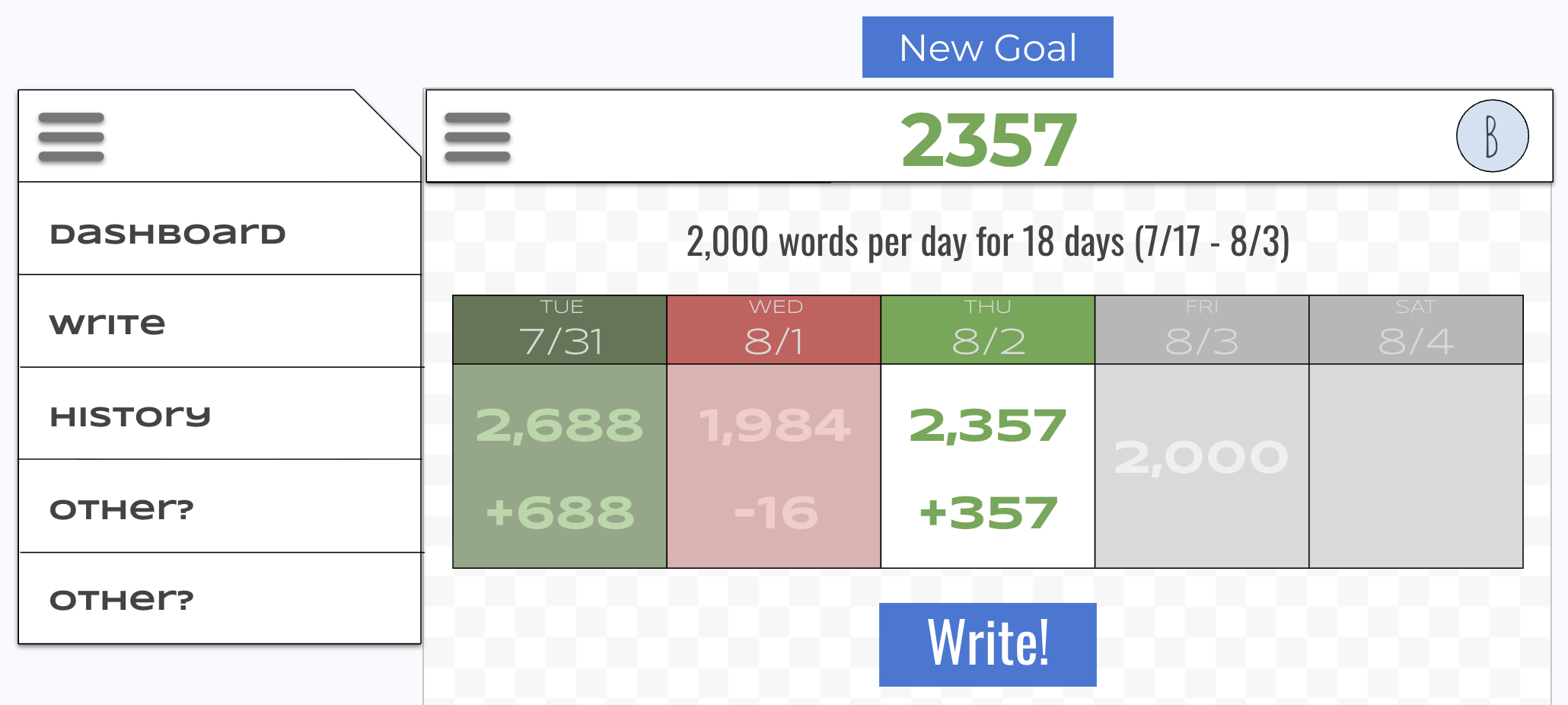 (Old 2018 Mockup)
And then later on, Google Docs got Dark Mode in mobile, but the Desktop app—the one I actually use most—STILL DOESN'T HAVE ONE...which prompted me to make the app have a variety of themes, each with its own light and dark variation, so that not only is there a proper Dark Mode, but the options give a breath of fresh air depending on the story, mood, or day's general vibe.
I had DailyWrite up and running before this portfolio, so it's had a few rounds of feature updates since going live. There are different types of goals now for casual writers and people who would still rather manually track chapters or arcs instead of straight-up word counts, though it's admittedly not perfect. There's an option to set the document to use Standard Manuscript Format, though it's not something you can see directly in the editor. Tabs and subtabs have had an overhaul or two, and goals can have "Cheat Days;" "Rest Days;" and even "Rollover Days" through some additional options when making a new goal.
DailyWrite is a Next.js application and uses TipTap for the writing editor. It connects with Google Docs API for most of the heavy lifting and Google Drive API to display the user's files. It uses Firebase to store user goals and writing sessions (days). Google OAuth handles login and authentication, and it's VERY adamant to make sure users know that the app is not secure. Maybe I'll shell out some money someday so it stops showing that warning. 🤷♀️
There are still plenty of bugs that need to be sorted out, along with a handful of features I still want to implement; but I happy with where it's at, and I'm finally at a point where I'm content to stop fiddling with it and actually use it for its intended purpose. For myself. Do I know whether or not it will actually help me achieve my goals of building a daily writing habit? No, not really. ADHD is a dreadful demon to fight. It's hard to say whether turning a day green will be novel for long enough to truly turn my desire into something that sticks...but even if it doesn't, I can at least be really proud of what I've created and the utility it COULD provide!